Architecture & Design
Half of Rome is Built From Marble
Alex Walker · 2 days ago
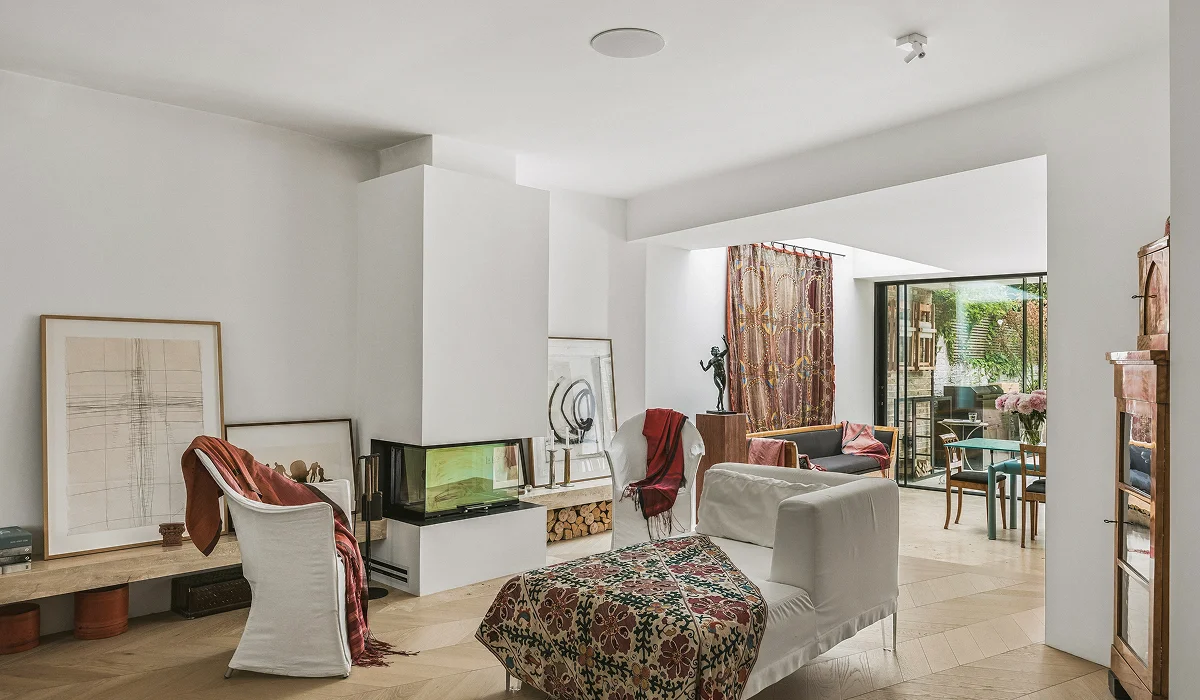
Architect Johanna Molineus on redesigning her own Kensal Rise home: travertine from an Italian quarry, plans drawn straight onto the walls, and when it’s fine to go to IKEA.
One thing is abundantly clear when you listen to Johanna Molineus speak about interior design: here is someone practically overflowing with insight. That’s unsurprising, given a multi-decade career that started in Tokyo, moved to Berlin and, more recently, brought her and her practice here to London. Her past projects have won her both accolades and admirers within the industry. But the project we sat down to discuss was more personal, and something many homeowners will relate to: the struggles and ecstasies of redesigning your own home.
Come in small, then open up
Resilience, both in maintaining your stamina through what might be a long project and in protecting the integrity of your concept, stands out as one of Molineus’s most foundational principles. In the case of this home, the concept was its unique shape, starting narrow and opening up to a large outdoor space.
“I wanted to make sure that when you came in, you came in very small and then it just opens up and then you have the whole thing expanding out.”
This lodestar, she explains, helps the process keep its footing in the face of the changes that are inevitable when you redesign a home.
“In my design, I made mistakes, but the overall vision never changed.”
A calculated risk
Of course, scope creep is a danger. But Molineus faced a dicier proposition, one that might well make amateurs bite their nails: an intervention from the council in the form of a planning enforcement.
“I didn’t build as per the planning application,” she says. She’d changed “a very lightweight structure” into “a solid structure with a huge skylight”.
“I resubmitted a planning application and it was granted.” It was a calculated risk, but one she was comfortable taking with her own home, given her nous and experience as an architect. Had the renewed permission not come through, she says, she would simply have had to take it down again. Audacious? Perhaps. But this, Molineus explains, is one of the key differences between designing for a client and redesigning your own home. There’s a freedom to take risks you would never take in other contexts.
Like drawing designs on site, rather than from the office.
“I just went on site and I just drew it on the wall what I wanted, and I wasn’t afraid to make mistakes because I knew that I could just then change it and it wouldn’t be the end of the world.”
Where to spend and where to save
This type of calculated chance is also part of how Molineus managed cost. Take her choice of a young, local company to install the travertine that runs through the whole house as a theme, a material she travelled to a quarry in Italy to source herself. That tension between extreme due diligence and a free-wheeling approach runs through our conversation, and speaks to her expertise. Knowing when you cannot compromise and when it’s alright to loosen up a little is what marks her out as a veteran professional.
She thinks deeply about where, and how, it’s worth breaking best practice, and where you simply have to be rigid in your commitment to quality.
“Make sure the skeleton of the building is solid, and then, you know, if you run out of money, which I did many times, I had to stop my build on two occasions just so I could recuperate a little bit, it’s okay to go to IKEA and buy a bit of joinery.”
Built to be lived in
It’s also obvious from talking to Molineus that the use of the space is paramount. A home doesn’t live simply as an aesthetic object but as a place to live, and in her case that meant room for entertaining, an essential characteristic of the home she set out to design. The same goes for balancing elegance with homeliness. She pushes back on our framing of the two as opposite poles.
“I don’t think one is exclusive of the other,” she says. “Half of Rome is built from marble!”
Wood and stone, she points out, are natural materials, and part of their value is the way they can actually improve with weathering, unlike artificial substitutes that may be cheaper upfront but lack those qualities. She even cites a previous project with leather flooring, one of the most extreme examples of an expensive organic material meeting heavy wear.
“Leather is a very heavily used material and the longer you use it or the more you use it, the nicer it looks… They’re all natural materials, so you just need to work with it and just let it grow… If you spill something, you wipe it up, right?”
Four renovation tips from an architect
Our talk with Molineus was not only an insightful look at her process as an architect and designer. It also came with a rich list of dos and don’ts for anyone’s renovation. Below are the four most essential principles she shared with us.
Start from the space, or start from an object
In some cases, the space has primacy, and your job is to complement and fill it. But design can also run in the other direction. Molineus gives the example of a set of door handles she found years ago, which she knew instantly she wanted to use in a future design, before she knew which project they would belong to. Whether it’s a piece of furniture or an artwork, it’s perfectly valid to start from an object you love and organise the rest of the space around it. What those objects are, at least for Molineus, is very personal. It needs to be driven by your own taste.
Don’t compromise on big-ticket items
When it comes to budgeting for a renovation, what Molineus calls big-ticket items are the ones you should never try to cut costs on. That means flooring, tile work and structural changes.
Prioritise what you use the most
For Molineus, entertaining is a key part of how she uses her home, so she prioritised it in both space and design attention. For you, it may be the bathroom rather than the kitchen, or your entryway. Identify the parts of the home where you’ll get the most pleasure, and prioritise those.
Don’t be too precious about organic materials
Organic materials may cost more upfront, and many people assume a big spend on, say, a marble countertop means walking on eggshells around the kitchen, afraid to drop anything or set a glass down. That’s a false economy. In the long run, expensive organic materials age better in most cases than cheaper artificial alternatives, and weathering gives them a sense of history and personality. They don’t need to be coddled.
Written by Alex Walker, lead writer at North by West.